


What Are Recurring Payments?
Recurring payments have become a standard part of everyday life. Consumers use them to pay for everything from streaming services and gym memberships to software subscriptions, utility bills, and subscription boxes. For businesses, recurring payments create predictable revenue, improve customer retention, and simplify billing operations. As subscription-based business models continue to grow, implementing a recurring payment strategy is becoming increasingly important.
If you’re considering offering subscription products or services, understanding how recurring payments work is the first step toward building a successful recurring revenue model.
What Are Recurring Payments?
Recurring payments are automatic payments that are collected from a customer’s payment method on a scheduled basis. Once a customer provides authorization, payments are processed automatically according to an agreed-upon billing cycle. Recurring payments may be processed:
- Weekly
- Monthly
- Quarterly
- Annually
Unlike one-time transactions, recurring payments eliminate the need for customers to manually submit payment information each time a bill is due.
As discussed in our Guide to Understanding Recurring Payments, recurring billing allows businesses to automate payment collection while creating a more convenient experience for customers.
How Do Recurring Payments Work?
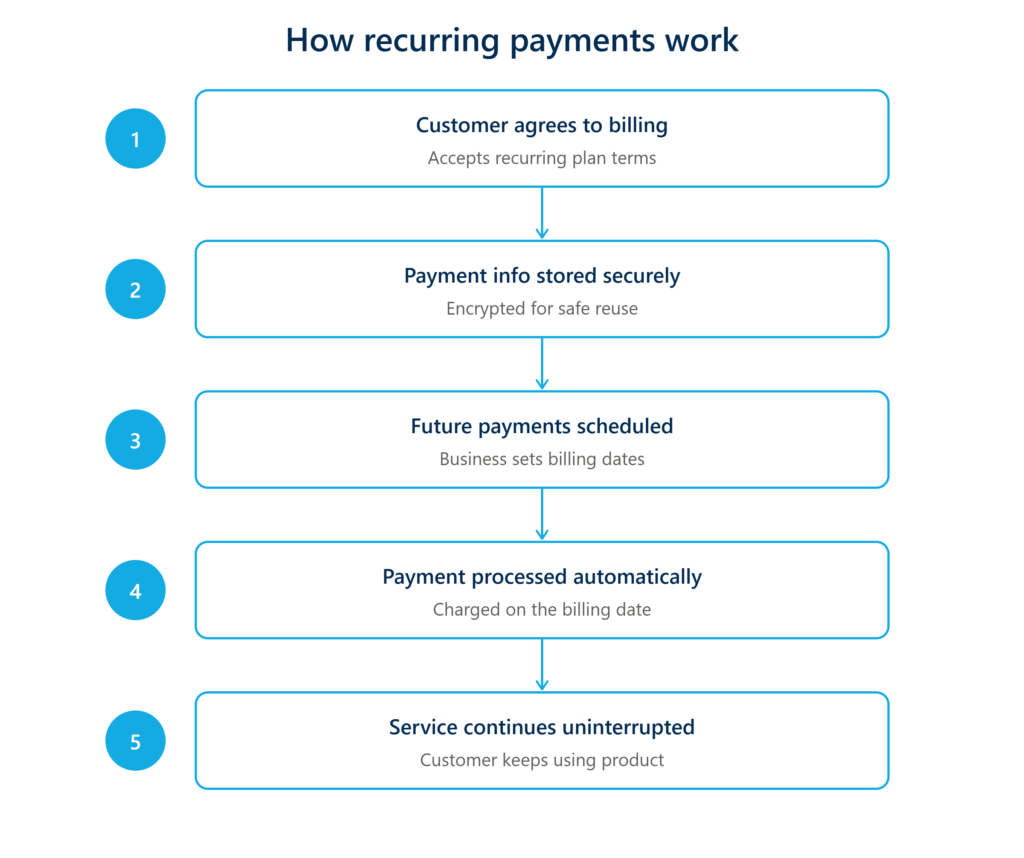
The payment process repeats until the customer cancels the service, updates payment information, or the agreement ends. Payment gateways automate this entire process, making it easier for businesses to manage recurring revenue while maintaining payment security.
Why Are Recurring Payments Growing in Popularity?
According to SUBTA, the subscription, membership, and loyalty industry grew to an estimated $3 trillion in 2024, up from $2 trillion in 2023.
Types of Recurring Payments
There are two primary types of recurring payments.
Fixed Recurring Payments
Fixed recurring payments charge the same amount during every billing cycle.
Examples include:
- Gym memberships
- Streaming subscriptions
- Membership organizations
- Software subscriptions with flat pricing
For example, a customer may pay $29.99 every month for access to a software platform.
Variable Recurring Payments
Variable recurring payments fluctuate based on usage or consumption.
Examples include:
- Utility bills
- Telecommunications services
- Utility management platforms
- Consumption-based SaaS pricing
The payment amount changes each billing cycle, while the automatic payment schedule remains in place.
Benefits
Recurring payments offer significant advantages for businesses looking to scale and improve financial predictability.
1) Predictable Revenue
One of the biggest advantages of recurring billing is predictable cash flow.
Rather than relying solely on new sales each month, businesses can forecast future revenue more accurately based on active subscribers and recurring customers.
This predictability helps support:
- Budget planning
- Staffing decisions
- Inventory forecasting
- Growth initiatives
2) Improved Customer Retention
When customers enroll in recurring billing, they are more likely to remain engaged with your product or service over time.
Reducing payment friction encourages customers to maintain their subscriptions and continue purchasing from your business.
3) Increased Operational Efficiency
Manually sending invoices and collecting payments requires significant administrative effort.
Recurring payment automation helps businesses reduce:
- Manual billing tasks
- Collection efforts
- Payment follow-up activities
- Processing delays
4) Better Customer Experience
Customers appreciate convenience. Recurring billing removes the need to remember payment dates or re-enter payment information for every transaction. The simpler the payment experience, the more likely customers are to remain loyal.
Common Industries That Use Recurring Payments
Recurring payments support a wide variety of business models. Industries commonly using recurring billing include:
- Software as a Service (SaaS)
- Membership organizations
- Nonprofits
- Fitness centers
- Media and publishing companies
- Telecommunications providers
- Utility companies
- Subscription box services
- Professional service providers
- Home service businesses
Any business that bills customers on a regular schedule can benefit from recurring payment processing.
What Payment Methods Support Recurring Payments?
Today’s businesses have several recurring payment options available.
Credit and Debit Cards
Card payments remain one of the most common recurring billing methods. Modern payment gateways can automate recurring card transactions while supporting features designed to reduce payment failures.
ACH Payments
ACH payments allow businesses to collect funds directly from a customer’s bank account. According to Nacha, the ACH Network processed 33.6 billion payments worth $86.2 trillion in 2024, underscoring the critical role electronic payments play in the U.S. financial system.
ACH payments are often attractive because they typically carry lower processing costs than credit card payments.
Digital Wallets
Many recurring payment platforms now support digital wallets, including Apple Pay and Google Pay. Providing multiple payment options can improve customer convenience and increase conversion rates.
How Businesses Can Reduce Recurring Payment Failures
Failed payments are one of the most common causes of involuntary churn. Fortunately, businesses can implement several strategies to improve transaction success rates.
1) Use Account Updater Services
When customers receive new cards because of expiration, fraud, or replacement, recurring payments can fail due to outdated payment credentials. Account Updater automatically retrieves updated card information from participating card issuers and updates stored payment credentials. This helps businesses maintain continuous billing and reduce failed transactions.
Learn more about Account Updater
2) Optimize Recurring Payment Processing
Businesses should also review their overall payment configuration and authorization strategy. Our article Recurring Payment Processing: 3 Proven Ways to Increase Transaction Approvals explains how businesses can improve authorization rates through proper merchant account configuration, accurate MCC setup, local acquiring, and payment optimization strategies.
3) Implement Network Tokenization
Network tokenization helps protect cardholder data while improving payment continuity and authorization performance. For a deeper dive, read Network Tokenization 101
4) Monitor Decline Codes
Understanding decline codes helps businesses identify whether payment failures result from insufficient funds, expired cards, issuer declines, or technical issues. Reviewing payment data regularly can help reduce unnecessary revenue loss.
For additional guidance, see A Merchant’s Guide to Payment Optimization
What Should Businesses Look for in a Recurring Payment Gateway?
Choosing the right payment provider can have a significant impact on payment performance and customer retention.
Look for providers that offer:
- Experience supporting recurring payments
- Account Updater services
- Multiple payment methods
- Strong security controls
- Payment optimization tools
- Transparent pricing
- Robust integrations
For more information, read:
Frequently Asked Questions
What is the difference between recurring payments and subscription payments?
Subscription payments are a type of recurring payment. While all subscription payments are recurring payments, recurring billing can also be used for utilities, services, memberships, and installment plans.
What are fixed and variable recurring payments?
Fixed recurring payments charge the same amount each billing cycle, while variable recurring payments change based on usage, consumption, or service activity.
How can businesses reduce recurring payment failures?
Businesses can reduce payment failures by using Account Updater services, optimizing recurring payment processing, monitoring decline codes, and implementing technologies such as network tokenization.
The Bottom Line
Recurring payments help businesses create predictable revenue, reduce administrative work, and improve customer convenience. Whether you’re launching a subscription business or modernizing your billing processes, implementing recurring payments can strengthen customer relationships and support long-term growth.
To learn more, download our Recurring Payments: A Complete Business Guide, which covers recurring billing models, key benefits, payment methods, and what to look for in a recurring payment provider.