

Resources
Failed Payment Recovery Strategies for Subscription Businesses
Every month, millions of subscription customers lose access to services they want to keep — not because they chose to leave, but because a payment failed silently in the background. An expired card. A temporary hold. A bank’s risk filter firing at the wrong moment. The subscription ends, the revenue disappears, and no one made a decision to cancel.
This is called involuntary churn — and it is one of the most underestimated revenue threats in the subscription economy. This guide exists to help subscription businesses understand, measure, and systematically recover failed customer payments before they become permanent losses.

The gap between the median 47.6% recovery rate and what top performers achieve — 70 to 85% — represents millions in recoverable revenue for most subscription businesses. This guide maps the path from average to best-in-class.
The Subscription Economy & the Payment Problem
A Market Built on Recurring Revenue
The global subscription economy reached $492 billion in 2024 and is projected to grow at a 13.3% CAGR through 2033, approaching $1.51 trillion. From SaaS to streaming to subscription boxes, recurring billing has become the default revenue architecture for modern businesses.
With this growth comes a fundamental vulnerability: every single subscriber represents a monthly or annual payment that must succeed — automatically, without the customer present, month after month. Unlike one-time commerce where a declined card simply means a lost sale, a failed recurring payment means a lost customer, plus every future payment that customer would have made.
The Hidden Revenue Leak
Most subscription businesses focus on acquisition and voluntary churn. They measure sign-up rates, cancellations, and NPS scores. But they frequently overlook the customer who never cancelled — whose payment just stopped working.
The consequences cascade beyond lost revenue. Research from Recurly found that 100% of surveyed subscription businesses reported negative consequences from failed payments, including decreased customer lifetime value (65%), lost revenue (61%), and increased operational costs to chase down failed payments (31%).
Why This Problem is Structurally Unique to Subscriptions
In one-time commerce, a declined card is visible to the customer at the moment of checkout. They can try another card, use a different method, or come back later. In subscription billing, the failure happens invisibly:
- The customer doesn’t initiate the transaction — your system does
- The failure may not surface for days, if ever
- The customer may not know service is interrupted until they try to log in
- 62% of users who encounter a payment error never return to the site (industry research)
- 35% of cardholders are likely to abandon a merchant after experiencing a decline (Checkout.com)
This invisibility is what makes failed customer payment recovery so critical — and so often overlooked until the impact on monthly recurring revenue (MRR) becomes impossible to ignore.
Why Recurring Payments Fail
Understanding why payments fail is the prerequisite to recovering them. Not all declines are created equal — and treating them as if they are is the single most common mistake in payment retry strategies.
For a complete technical breakdown, see our companion article: Why Recurring Payments Fail →
Soft Declines vs. Hard Declines
Payment failures fall into two fundamental categories, each requiring a completely different response:

The Most Common Causes of Failed Subscription Payments
Expired or Reissued Cards
Cards expire. Banks reissue cards after fraud, upgrades, or account changes. Expired or reissued cards cause roughly 10–15% of recurring payment failures. A card that was valid at signup may expire months later — and unless your system updates it automatically, the next billing cycle fails. In many portfolios, up to half of all hard declines originate from stale card credentials.
Insufficient Funds
The customer has the intent to pay, but the funds aren’t available at the exact moment your billing system fires. This is especially common when billing occurs at the same time across a large customer base, or when billing date falls before a customer’s typical payday. Timing the retry strategically — after likely payday windows — can recover a significant share of these failures.
Bank-Side Risk Filters
Issuing banks run sophisticated fraud and risk models on every transaction. A recurring charge that looks different from the expected pattern can trigger a soft decline even when the card is valid and funds are available. A new subscription amount after a plan change, a charge at an unusual time of day, or a billing descriptor the bank’s system doesn’t immediately recognize can all trigger a false decline.
Temporary Holds and Timing Mismatches
A customer may have the funds to cover the charge, but a pending hold from another transaction temporarily reduces their available balance. Retry the same charge 48 hours later and it clears; retry it 10 minutes later and it fails again with the same unhelpful decline code.
Technical and Data Issues
Every payment transaction involves over one hundred data points passed between your system, the processor, the payment network, and the card issuer. Mismatches in ZIP codes, billing address fields, CVV data, or other identifiers can cause declines that have nothing to do with the customer’s ability or intent to pay. As Butter Payments notes, subscription payment failures are often a data problem, not a customer problem.
Single-PSP Bottlenecks
Subscription businesses that route all transactions through a single payment service provider expose their entire recurring revenue base to that provider’s outages, routing issues, or network throttling. A single PSP going down during a billing run can fail an entire month’s renewals simultaneously.
The True Business Impact of Failed Payments
The Revenue Math
Failed payments aren’t just a billing inconvenience — they’re a direct revenue and growth threat. The numbers are stark:

To put this in concrete terms: a subscription business with $10 million in annual recurring revenue and a 7.9% payment failure rate has $790,000 in revenue at risk. Even at a 60% recovery rate, that business still permanently loses $316,000 annually — more than enough to fund a dedicated recovery function many times over.
The Hidden Costs Beyond Lost MRR
The revenue impact of failed payments understates the total business cost. Each involuntary churn event also carries:
- Lost Customer Lifetime Value — the customer’s future spend that will never be realized
- Customer Acquisition Cost written off — the marketing and sales spend to acquire that subscriber, now wasted
- Operational overhead — customer service tickets, manual outreach attempts, billing disputes
- Brand damage — service interruptions erode trust even when the customer is re-engaged
- Compounding effect — each lost subscriber also removes word-of-mouth and referral potential
Research from Slicker quantifies this cascading effect: if your current recovery rate is in the low-to-mid 50s, a well-optimized program should achieve rates in the high 60s to low 70s — a lift worth measuring in tens or hundreds of thousands annually.
The Failed Payment Recovery Framework
Recovering failed customer payments isn’t a single action — it’s a layered system. Best-in-class businesses layer multiple recovery mechanisms that each catch a different segment of the failure population.
The Three-Layer Recovery Stack
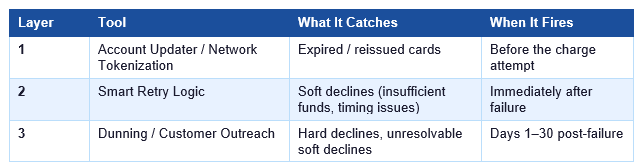
Layer 1: Account Updater & Network Tokenization
Account updater services automatically refresh expired or reissued card credentials with the card networks (Visa, Mastercard) before a charge is even attempted. Network tokenization replaces raw card numbers with cryptographic tokens that auto-update when cards are reissued. Smart dunning systems using automatic card-updater services can recover up to 20% more invoices before a retry is even needed.
Layer 2: Smart Retry Logic
When a payment fails, the timing and method of your next attempt matters enormously. A dumb retry attempts the same card through the same processor at the same time of day — it will fail the same way every time. A smart retry adapts based on the decline reason, the customer’s context, and real-time performance data. Dynamic retries recover 7.8% more purchases and deliver a 36% relative improvement versus static retry schedules.
Layer 3: Dunning & Customer Communication
For failures that automated retries cannot resolve, direct customer outreach is essential. Dunning is the process of communicating with customers about their failed payment — via email, SMS, and in-app notifications — to prompt them to update payment information. The tone matters as much as the timing: recovery emails should read like a helpful nudge from a product the customer likes, not like a debt collection notice. See Dunning Management for Subscriptions for more information.
Payment Retry Strategies That Work
For a deep dive into retry logic and implementation, see: Subscription Subscription Payment Retry Strategy →
The most common dunning mistake is using a static retry schedule — attempting the same payment at predetermined intervals regardless of why it failed. Modern retry strategy is far more nuanced.
Decline-Specific Retry Timing

Multi-Provider Retry Routing
A retry through the same processor that declined the original transaction may fail for the same reason. Routing the retry through a different processor or acquirer can succeed where the original failed — especially for timeouts, technical errors, and some bank declines. This requires a centralized, portable token vault so stored credentials can be used across multiple providers.
AI-Powered Recovery
The newest generation of payment recovery uses machine learning to optimize every aspect of the retry process — timing, routing, communication channel, and message content — based on real-time data across millions of transactions.

AI-powered platforms achieve these results by analyzing patterns across card type, geography, decline code, customer tenure, billing day of week, and dozens of other signals. The result: individualized retry timing per transaction rather than a one-size-fits-all schedule. Companies that implement AI-powered recovery strategies typically see 20–50% increases in recovered revenue.
Failed Payment Recovery Benchmarks by Segment
Recovery rates vary significantly by business type, average contract value, and the maturity of the recovery program. Use these benchmarks to evaluate where your business stands:

The 47.6% industry median from Recurly’s benchmark study means that for every 100 failed payments, the typical subscription business successfully recovers fewer than 48. The remaining 52+ payments represent pure, preventable revenue loss.
Failed Payment Recovery Action Checklist
Use this checklist to audit your current recovery stack and identify gaps:
Prevention (Before the Failure)
- Enable Account Updater services through Visa and Mastercard network programs
- Implement network tokenization for all stored recurring payment credentials
- Send pre-billing notifications 3–5 days before renewal attempts
- Block BIN types unsuitable for recurring billing (virtual cards, gift cards)
Recovery (After the Failure)
- Parse decline codes and categorize every failure as soft or hard
- Apply decline-specific retry timing (not a uniform fixed schedule)
- Route retries through alternative processors where available
- Send Day 0 dunning email immediately after failure (41% open rate)
- Layer SMS outreach from Day 8 for unresolved failures
- Set a grace period to maintain service access during recovery window
- Close recovery window at Day 27–30 and suspend unpaid subscriptions
Measurement (Ongoing)
- Track recovery rate weekly (target: above the 47.6% industry median)
- Monitor MRR at risk and recovered MRR separately
- Analyze failure distribution by decline type, card type, and customer segment
- Run quarterly audits against industry benchmarks by vertical
Final Thoughts
Failed payment recovery is essential for protecting recurring revenue and reducing involuntary churn. By using intelligent retries, dunning management, and proactive customer communication, businesses can recover otherwise lost payments and keep more subscribers active.
A strong failed payment recovery strategy doesn’t just improve revenue—it strengthens customer retention, increases lifetime value, and supports long-term subscription growth.
Frequently Asked Questions
What is failed payment recovery?
Failed payment recovery is the process of recovering revenue from unsuccessful payment transactions through strategies such as payment retries, customer notifications, payment method updates, and automated dunning workflows. It helps businesses reduce revenue loss and retain customers.
Why do recurring payments fail?
How much revenue is lost due to failed payments?
What is involuntary churn?
What is dunning management?
How many times should a failed payment be retried?
While the optimal approach varies by business and decline reason, many subscription businesses use a retry strategy that includes multiple attempts over several days combined with intelligent retry logic to maximize recovery rates.
What is intelligent payment retry logic?
How can businesses improve failed payment recovery rates?
Related Resources
Subscription Payment Recovery: How to Reduce Churn and Recover Recurring Revenue
Why Payments Fail: Common Causes of Failed Recurring Payments
Why Decline Codes Are Key to a Smarter Payment Retry Strategy
Dunning Management for Subscriptions
Understanding Visa’s Excessive Reattempts Rule: Penalties, Decline Codes & How to Stay Compliant