

How Account Updater Helps Reduce Failed Subscription Renewals
For subscription businesses, a failed renewal payment doesn’t always mean a customer wants to leave. Sometimes the problem is simply outdated payment information.
Account Updater helps reduce failed subscription payments by automatically refreshing stored card information when a customer’s eligible card expires, is replaced or is reissued. Keeping card-on-file credentials current can help subscription businesses prevent avoidable payment declines, reduce involuntary churn and protect recurring revenue.
However, Account Updater addresses only certain causes of failed payments. For a more complete approach, subscription businesses should combine it with other payment recovery tools and technologies, including retry strategies and network tokenization.
Why Do Subscription Renewal Payments Fail?
Subscription businesses depend on successfully charging customers at regular intervals. The longer a customer remains subscribed, the more likely it is that something will eventually change with the payment credentials stored on file.
Common causes of recurring payment failures include:
- Expired cards
- Cards reissued after being lost or stolen
- Replacement cards following suspected fraud
- Changes to card or account information
- Insufficient funds
- Temporary issuer declines
- Fraud prevention or risk controls
When a customer still wants the product or service but the renewal payment fails, the resulting cancellation can lead to involuntary churn.
Businesses looking to understand the broader causes should also read Payway’s article on why subscription payments fail.
What is Account Updater?
Account Updater is a payment service that helps keep stored card-on-file information current when participating card issuers and card networks provide updated payment credentials. If an eligible customer’s card expires, is replaced or is reissued, updated information can be made available so future recurring payments can be processed using current credentials.
In practical terms, Account Updater can eliminate the need for some customers to manually update their payment information before their next subscription renewal.
Instead of discovering the problem after a payment has already failed, the business may receive updated payment credentials in the background. This helps create a more seamless recurring payment experience for both the merchant and the subscriber.
How Does Account Updater Help Prevent Failed Subscription Payments?
Account Updater targets a specific problem in recurring billing: stored payment credentials becoming outdated over time.
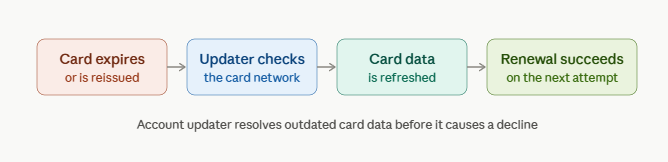
Imagine a customer who subscribes to a service using a credit card that later expires or is replaced. The customer may have every intention of remaining subscribed but forget to update the card saved with the merchant.
Without updated payment information, the next renewal transaction may fail.
With Account Updater, eligible card information can be refreshed before a future recurring transaction is processed. This gives the merchant a better opportunity to complete the renewal without requiring action from the customer.
The potential benefits include:
- Fewer payment failures caused by outdated card information
- Fewer interruptions to recurring billing
- Less need for customers to manually update eligible cards
- Reduced administrative effort associated with payment recovery
- Lower risk of involuntary churn
- Better subscription continuity
For a recurring-revenue business, avoiding the decline in the first place can be preferable to trying to recover the payment after it fails.
How Can Account Updater Help Reduce Involuntary Churn?
Account Updater can help reduce involuntary churn by preventing some payment failures caused by outdated card credentials.
Involuntary churn occurs when a subscriber is lost because of a payment problem rather than an intentional decision to cancel. A customer whose card expires, for example, may still be a satisfied subscriber. If the business cannot successfully collect the next payment, however, that customer’s subscription could eventually be interrupted or canceled.
Keeping eligible stored payment information current reduces some of this friction.
This matters because retaining an existing subscriber isn’t just a billing concern. Successful renewals help protect recurring revenue and customer lifetime value.
What Types of Providers Offer Account Updater Services?
Account Updater capabilities can be available through different parts of the payment ecosystem. These may include:
- Card networks, which provide underlying card-update capabilities
- Payment gateways that offer Account Updater alongside transaction processing
- Payment processors specializing in recurring payments that integrate Account Updater with other subscription payment and recovery capabilities
- Standalone solutions focused on updating stored payment credentials
For businesses that depend heavily on recurring revenue, the question shouldn’t simply be,“Do you offer Account Updater?” A more useful question is: “How does Account Updater fit into your overall recurring payment and payment recovery strategy?”
Account Updater can solve one important problem, but subscription businesses typically encounter multiple types of payment failures.
What Should You Look for in an Account Updater Provider?
When evaluating an Account Updater solution, consider how well the provider supports the entire recurring payment lifecycle.
Look for these capabilities:
- Experience with recurring payments and subscriptions
A provider that understands recurring billing should be equipped to handle ongoing card-on-file relationships rather than approaching every transaction as a one-time payment. - Card-on-file and stored credential support
Ask how the provider manages stored payment credentials and how Account Updater integrates with your existing recurring billing processes. - Simple integration
Understand the technical requirements, implementation timeline and how the Account Updater capability works with your current billing environment. - Payment security and tokenization
Payment credentials should be handled securely. Consider how Account Updater works alongside tokenization and other payment security technologies. - Reporting and payment visibility
Look for reporting that helps you understand why transactions are declining and what happens to failed renewal payments. - Payment recovery capabilities
Account Updater doesn’t resolve every type of decline. Determine what happens when a recurring payment still fails. - Responsive support
When recurring revenue is at risk, access to knowledgeable support matters. - Transparent pricing
Understand how Account Updater and other payment recovery capabilities are priced before choosing a provider.
The objective isn’t simply to find a company that offers Account Updater. It is to find a payment partner that can help improve the overall performance of your recurring payments.
Is Account Updater Enough to Prevent All Failed Payments?
No. Account Updater cannot prevent every failed subscription payment.
It primarily addresses payment failures associated with outdated card information. Other recurring transactions can fail because of issues such as insufficient funds, temporary issuer declines, authentication problems or fraud-related controls.
That’s why Account Updater is best viewed as one component of a broader subscription payment recovery strategy.
A comprehensive strategy can include:
- Account Updater to help keep eligible card-on-file information current
- Network tokenization to replace sensitive card information with network-issued payment tokens
- Payment retry strategies for appropriate recoverable declines
- Dunning and customer communications when customer action is necessary
- Decline reporting and analytics to understand why transactions are failing
- Payment security and fraud prevention tools to help protect transactions
Payway’s broader subscription payment recovery article explains how these technologies and processes can work together.
Account Updater vs. Network Tokenization: What’s the Difference?
Account Updater and network tokenization both can play a role in keeping recurring payments running, but they are not the same technology.
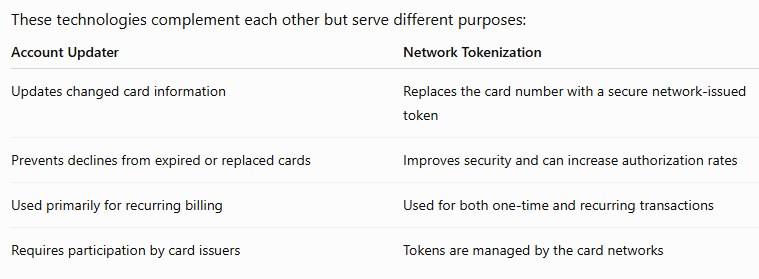
Account Updater helps refresh eligible stored payment credentials when card information changes. Network tokenization replaces sensitive card information, such as the primary account number, with a payment token generated by a payment card network. Network tokens can also help maintain payment continuity as underlying card credentials change.
The technologies can therefore complement each other within a subscription payment strategy.
For a deeper explanation, read Network Tokenization 101.
Treating account updater as the entire solution leaves a meaningful share of avoidable churn unaddressed. Treating it as one layer of a payment recovery strategy is what actually moves the needle on recurring revenue retention.
Final Thoughts: Build a More Complete Recurring Payment Strategy
Preventing failed subscription renewals requires more than successfully processing the initial transaction. Businesses need to think about what happens to stored payment credentials months or even years into the customer relationship.
Account Updater helps address a common source of friction by keeping eligible card information current without requiring the subscriber to manually intervene. When combined with payment recovery processes, retry strategies, network tokenization and strong payment reporting, it can help businesses create a more resilient recurring payment environment.
Payway is built for businesses with recurring revenue models, providing Account Updater alongside payment processing, security and payment recovery capabilities designed to help businesses reduce failed payments and retain more customers.
Ready to learn how Payway can help you improve recurring payment performance? contact us to start a conversation.
Frequently Asked Questions
What is an Account Updater?
An Account Updater is a payment service that helps automatically refresh eligible stored card information when a customer’s payment card expires, is replaced or is reissued. Updated credentials can then be used for future card-on-file and recurring transactions, reducing the need for customers to manually update their payment information.
How does Account Updater work for recurring payments?
Account Updater helps recurring-payment merchants keep eligible stored card credentials current by obtaining available updates through participating payment card networks and issuers. When qualifying card information changes, the updated credentials can be used for future recurring transactions.
Can Account Updater prevent expired cards from causing subscription payments to fail?
Account Updater can help prevent payment failures when updated card information is available for an eligible card through participating networks and issuers. It does not guarantee that every renewal transaction will be approved because payments can decline for reasons unrelated to outdated card information.
Does Account Updater update cards automatically?
For eligible accounts, updated card information can be provided without requiring the customer to manually enter the new information with the merchant. Coverage depends on participating networks, issuers and the specific Account Updater service.
How does Account Updater reduce involuntary churn?
Account Updater can reduce involuntary churn by helping prevent some recurring payment failures caused by outdated card information. If an eligible card expires or is replaced, updated credentials can help a merchant continue billing a customer who still wants to remain subscribed.
What is the difference between Account Updater and network tokenization?
Account Updater helps refresh eligible stored card information when card details change. Network tokenization replaces sensitive card credentials with network-issued tokens and can help those stored payment credentials remain current as underlying card information changes. The technologies have different functions but can complement one another in a recurring payment strategy.
Is Account Updater enough to prevent all failed subscription payments?
No. Account Updater addresses certain failures associated with outdated payment credentials, but recurring payments can also fail because of insufficient funds, temporary issuer declines, fraud controls and other factors. Subscription businesses should combine Account Updater with additional payment recovery strategies when appropriate.
What should subscription businesses look for when vetting an account updater provider?
Look for a provider built around recurring payments rather than one-off transactions, with strong support for card-on-file and stored credential use cases. Beyond the core update feature, check for tokenization and PCI-DSS compliance, real-time reporting on declines and recovered payments, customer payment recovery options beyond just card refresh, transparent pricing, and responsive support. A provider that only offers card refresh — without visibility into results or a path to recover other types of declines — leaves value on the table.